


Over $22.7 billion lost to crypto hacks and scams since 2011. Over $3.4 billion stolen in 2025, with average total value locked across the ecosystem reaching $120 billion. A single Bybit breach in February 2025 accounting for $1.5 billion, the largest crypto hack ever recorded.
Regulators around the world are finally acting on what these numbers make obvious: crypto exchanges sit at the center of the digital asset economy. They are the primary gatekeepers.
A growing wave of regulatory action is now turning exchanges from passive trading platforms into active security enforcers. This is the shift the industry has been waiting for.
South Korea Fires the Starting Gun
Earlier this year, South Korea’s Financial Services Commission (FSC) leaked a draft bill that would fine hacked exchanges up to 10% of their stolen assets. Today, the maximum penalty for a breached exchange sits at roughly $456,000. Under the proposed law, Upbit’s $36 million hack in late 2025 would have triggered a $3.6 million fine instead. That’s a 700% increase.
A competing proposal goes further. South Korean lawmakers are considering fines of up to 3% of an exchange’s annual revenue. For Upbit, which reported $1.2 billion in 2024 revenue, that would have meant $36 million in penalties for a single breach.
The FSC is also moving to impose “no-fault” liability on crypto exchanges. This is the same standard applied to banks and electronic payment providers. It means exchanges would have to reimburse customers for losses from hacks or system failures regardless of whether the platform was at fault.
This is not a hypothetical discussion. South Korea’s five largest exchanges recorded 20 security incidents between January 2023 and September 2025. South Korean regulators are done waiting for the industry to fix itself.
A Global Trend, Not an Isolated Move
South Korea is not alone. Every major financial jurisdiction is tightening accountability standards for crypto platforms.
The EU’s MiCA regulation, fully enforceable since January 2025, permits fines of up to 12.5% of annual turnover for serious violations. National regulators across multiple member states have already begun enforcement actions, and firms operating without proper registration face license revocations that bar them from the entire EU market.
Japan’s FSA has required customer fund segregation and registered licensing since 2017. In 2025, it signaled plans to treat crypto holdings more like investment products, adding new layers of regulatory scrutiny. Dubai’s Virtual Assets Regulatory Authority (VARA) has been actively sanctioning unlicensed operators, fining 7 entities in October 2024 and another 19 in October 2025, while strengthening marketing and compliance requirements across the board.
The question is no longer whether regulation is coming. It is how fast security non-compliance becomes financially unsurvivable.
The Hypothetical Price Tag: What If These Rules Were Global?
The data from the last five years paints a stark pictureThat is nearly $12 billion in stolen assets over five years.
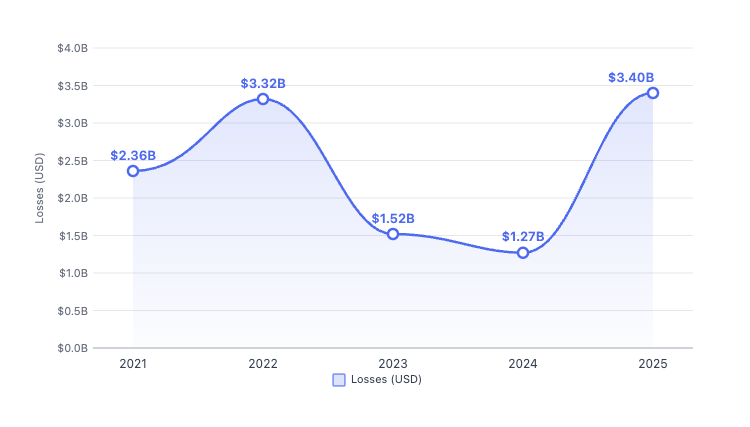
If South Korea’s proposed 10% fine on stolen assets were applied globally to other ecosystem participants such as DeFi platforms, they would have faced roughly $1.19 billion in cumulative penalties over that period.
Under the more aggressive 3% revenue-based model, the exposure multiplies dramatically. Binance alone reported $16.8 billion in revenue in 2024. A 3% revenue-based fine on just the top five global exchanges would likely exceed $1 billion in a single year.
And under MiCA’s 12.5% turnover ceiling? The penalty exposure for a major exchange could reach into the billions from a single incident.
When the cost of a security failure starts approaching the cost of the hack itself, the incentive structure flips. Prevention becomes an existential priority.
Exchanges as the Industry’s Security Backbone
Crypto exchanges are the infrastructure through which nearly every user, token, and dollar of liquidity flows. That makes them the single most efficient point of leverage for improving industry-wide security. It also makes their failure to use that leverage one of the industry’s most glaring shortcomings.
The reality is that exchanges have been more than willing to use their gatekeeper position to extract value from projects. Listing fees, marketing commitments, token allocations, exchanges have built highly effective mechanisms for monetizing their dominance. But they have not applied anywhere near the same force to raising crypto security standards.
This is a missed opportunity for all of us. There is no stronger set of forces acting on most protocols than the exchanges. When an exchange demands something as a condition of listing or continued support, projects comply. That power has been used extensively to drive commercial outcomes. It has barely been touched to drive security outcomes. If exchanges required comprehensive security audits, robust bug bounty programs, and verifiable incident response plans as non-negotiable conditions for listing, the security posture of the entire ecosystem would improve overnight.
When an exchange raises its security requirements, those standards cascade outward. Every project seeking a listing, every token issuer, and every protocol integrating with that exchange must meet the new bar. Exchange-level security requirements become de facto industry standards.
This is the same model that made traditional finance more resilient over the past century. Banks don’t just protect themselves. They also enforce compliance standards on every entity that touches their infrastructure. Regulators figured out long ago that holding gatekeepers accountable is the fastest path to system-wide improvement; but apparently we still haven’t.
Crypto is reaching that same inflection point. As regulatory pressure increases, exchanges will respond by investing more in prevention. They will expand security teams, run more comprehensive audits, adopt real-time threat detection, and build out robust bug bounty programs. Those investments raise the security floor for the entire ecosystem.
The Economics of Prevention
The numbers strongly favor proactive security over reactive damage control.
Consider that the largest bug bounty ever paid in web3, $10 million for a critical Wormhole bridge vulnerability, prevented billions in potential damage. Across the industry, structured bug bounty programs have already helped protect over $190 billion in user funds and have paid out more than $125 million to ethical hackers for responsible disclosures. That is what functional security economics looks like.
The alternative is that the average major exchange hack costs tens or hundreds of millions in direct losses, plus reputational damage, user attrition, regulatory scrutiny, and in some cases, total business failure. DMM Bitcoin, which lost $305 million in 2024, ultimately shut down and transferred its client accounts to another exchange.
A security investment that costs a fraction of a potential fine or hack payout is the highest-ROI capital allocation an exchange can make.
As regulatory fines scale upward globally, the platforms that have already built proactive security infrastructure will hold a decisive competitive advantage. They will face lower penalties, maintain licensing, attract institutional capital, and build the kind of user trust that no marketing budget can buy.
What Comes Next
The regulatory direction is locked in. From Seoul to Brussels to Singapore to Abu Dhabi, governments are converging on the same conclusion: crypto exchanges must meet the same accountability standards as banks and traditional financial infrastructure. Countries without strict exchange liability rules will look at the frameworks emerging in South Korea, the EU, Japan, and Singapore and build their own versions.
For exchanges, the message is clear: Invest in security now. Build comprehensive defense systems: audits, bug bounties, real-time monitoring, incident response, and continuous threat intelligence. The cost of prevention is a fraction of the cost of a breach, and that gap is about to widen dramatically as fines scale up worldwide. Don’t wait for regulators to force your hand. Every month of inaction is another month in which preventable hacks drain billions from the ecosystem and erode the trust that the entire industry depends on.
For the broader industry, this is a turning point. Top-down pressure on exchanges will do more to improve crypto security than any single technology, protocol upgrade, or industry pledge ever could. When the gatekeepers are held accountable, the entire market gets safer.
The exchanges that lead on security will define the next era of digital finance. The ones that lag behind will pay for it. Literally.