

The Vulnerability Apocalypse is what happens when the world finds vulnerabilities faster than they can be mitigated.
This is not a future scenario. It is already here. And the consequences extend far beyond cybersecurity operations. They reach into the foundations of the internet, the stability of financial systems, the safety of hospitals and power grids, the integrity of cloud infrastructure, and the survival of the open source ecosystem that holds all of it together.
The Shift in One Sentence
For decades, vulnerability discovery was the hard part, but no longer. AI and automation have made it cheaper and faster to find software vulnerabilities. But validating, triaging, prioritizing, reproducing, coordinating, and fixing those vulnerabilities still requires human judgment, institutional capacity, and time that no one has scaled.
Discovery scales faster than responsibility. That single asymmetry is driving a crisis that will reshape how the internet is secured, or left exposed.
The Numbers Are Already Overwhelming
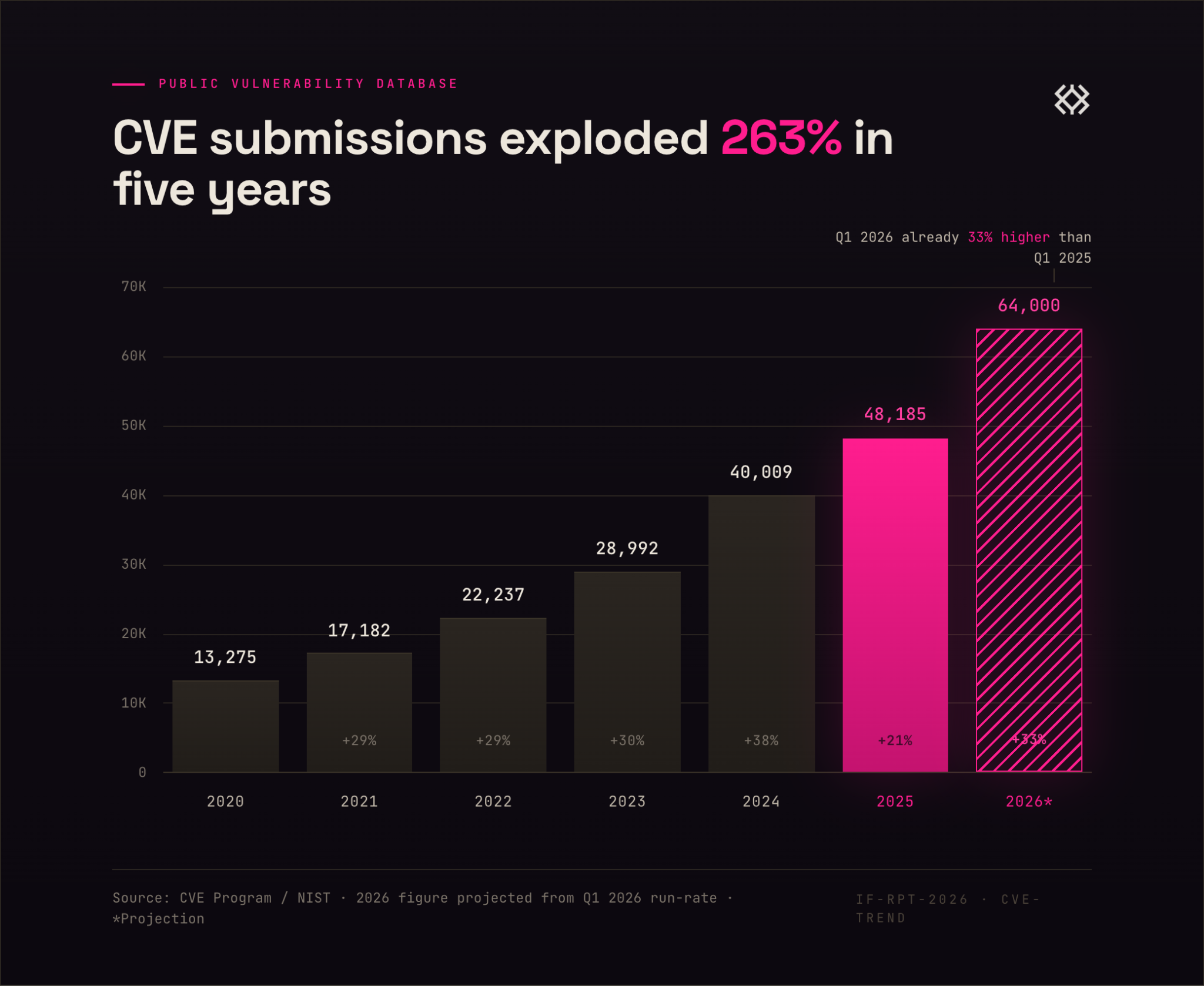
CVE submissions rose 263% between 2020 and 2025. The first quarter of 2026 was roughly a third higher than the same period in 2025. In April 2026, NIST acknowledged it could no longer keep up. Under its new model, only 15% to 20% of incoming CVEs are expected to receive full analysis. Roughly 29,000 delayed entries were marked “Not Scheduled.” NIST reviewed almost 42,000 CVEs in 2025, 45% more than any prior year, and still could not clear the backlog.
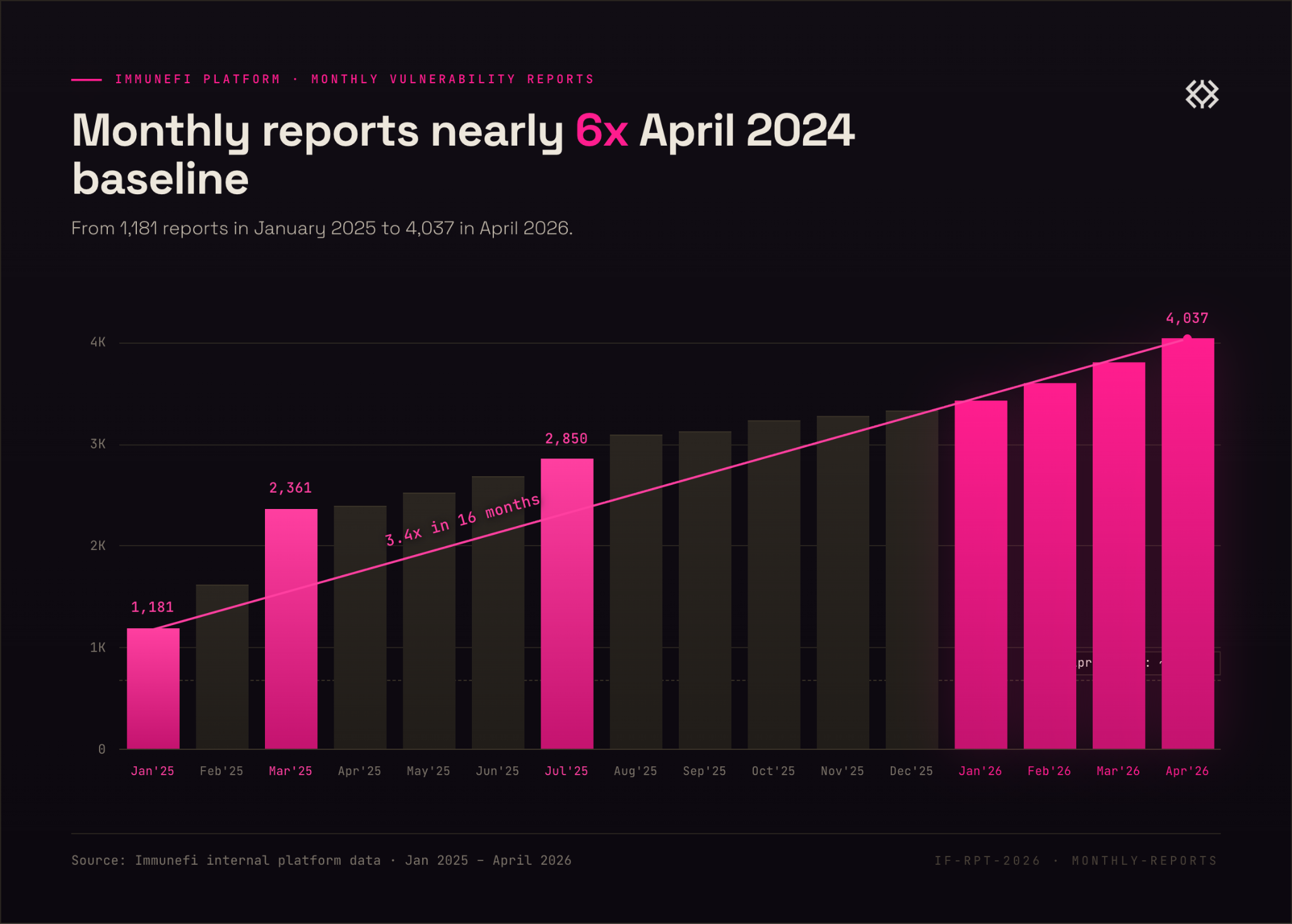
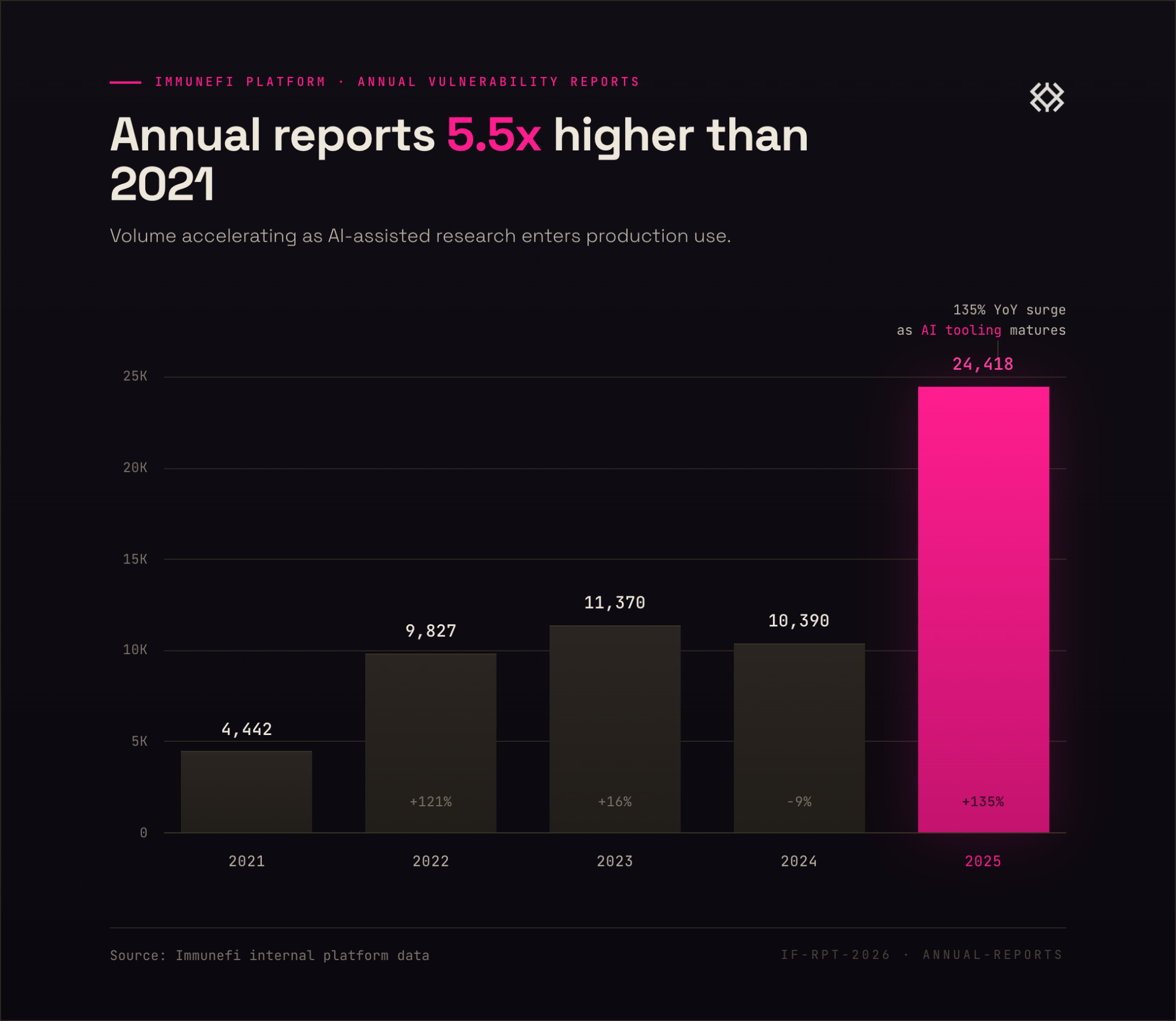
On @Immunefi, the leading crypto bug bounty platform, report volume hit 24,418 in 2025, a 135% increase from the prior year. Monthly submissions more than doubled year over year. In April 2026, 4,037 reports arrived in a single month, almost six times the volume from April 2024.
These are the numbers at current scale. The question is what happens next.
What Happens at Hundreds of Thousands
Imagine a world where AI-assisted vulnerability discovery reaches its natural throughput: not thousands of reports per month, but hundreds of thousands. Not dozens of CVEs per day, but hundreds.
This is not speculative. DARPA’s AI Cyber Challenge showed AI systems reviewing 54 million lines of code and finding 86% of target vulnerabilities at roughly $152 per task. Anthropic’s Claude Mythos Preview found more than 2,000 unknown vulnerabilities in major applications during seven weeks of testing, including 271 bugs in Mozilla Firefox, with working exploits for 181 of them. One OpenBSD vulnerability it uncovered had existed for 27 years. The UK’s AI Security Institute found that the length of cyber tasks frontier models can complete is doubling every few months.
When these capabilities become widely available, and they will, the volume of vulnerability reports hitting every intake system on the internet will be unlike anything the industry has experienced. Bug bounty platforms, open-source maintainers, corporate security teams, and public databases will face a simultaneous flood of legitimate findings, duplicates, false positives, AI-generated noise, and low-quality submissions, all of which look increasingly similar on the surface.
The systems that secure the internet will begin choking on the volume of reports about how insecure it is.
The Collapse of Open Source Triage
The first and most consequential failure point is open source.
Linux runs on virtually every server, cloud instance, Android device, embedded system, supercomputer, and satellite in the world. Critical libraries like OpenSSL, curl, zlib, and glibc are dependencies for millions of applications across every sector. The maintainers of these projects are often small teams or individuals who already operate at the edge of capacity.
Now give those maintainers a hundred times more vulnerability reports.
The cURL project already closed its bug bounty program after AI-generated reports consumed maintainer time without producing useful fixes. Its maintainer said the reports looked legitimate but rarely identified actionable vulnerabilities. Linus Torvalds said the Linux kernel’s private security mailing list had become “almost entirely unmanageable” because AI-assisted bug hunters were submitting duplicate and already-known reports at scale.
These are not obscure projects. cURL ships in nearly every operating system and connected device on earth. Linux is the substrate of the modern internet. When their maintainers are overwhelmed, the consequences do not stay inside a mailing list. They propagate outward into every system that depends on them.
And everything depends on them.
Second-Order Consequences: When the Foundation Cracks
When critical open-source projects cannot keep up with vulnerability intake, the failure cascades.
Consider what sits on top of Linux and its ecosystem of open-source libraries: Amazon Web Services, Google Cloud, Microsoft Azure, and every major cloud provider. Every major bank’s transaction processing. Hospital systems running electronic health records. Air traffic control systems. Power grid SCADA controllers. Telecommunications infrastructure. Government classified networks. NASA mission control. The SWIFT financial messaging network. Every major SaaS company. Every cryptocurrency protocol.
If a serious vulnerability is submitted to a Linux kernel maintainer, buried under 500 other reports, half of which are AI-generated duplicates and false positives, and it takes three weeks instead of three days to reach the right person, the entire internet is exposed for those extra eighteen days. Every cloud instance. Every server. Every device.
Now multiply that across every critical open-source dependency. A vulnerability in OpenSSL that goes untriaged for a month means that banks, hospitals, military systems, and cloud providers are all running exploitable code while the maintainer sorts through a queue they cannot clear. A flaw in a widely-used JavaScript library that gets lost in a backlog of thousands of reports means that SaaS applications serving hundreds of millions of users remain vulnerable while the one person who understands the codebase is buried in noise.
This is what the Vulnerability Apocalypse actually looks like. Not a dramatic breach announcement. A slow, systemic degradation of the world’s ability to respond to known dangers.
Projects stop accepting vulnerability reports because they cannot process them. Maintainers burn out and walk away. Bug bounty programs close or narrow their scope. Disclosure timelines stretch from weeks to months. Patches arrive late or not at all. The backlog becomes permanent.
And every item in that backlog is a vulnerability that someone, whether a criminal group, a state actor, or an opportunistic attacker, might find independently and exploit before it is fixed.
The Crypto Proof of Concept
Crypto has already lived through the early version of this problem, and the data reveals something important about what happens when bug bounties work, and what would happen if they didn’t.
In crypto, the financial incentives for both researchers and attackers are immediate and visible. A smart contract vulnerability is not an abstract risk assessment. It is a direct path to draining funds. The gap between “reported” and “exploited” is measured in hours, not quarters.
Immunefi’s data shows that the number of serious vulnerabilities responsibly disclosed through bug bounties is many times larger than the number of vulnerabilities that are actually exploited as hacks. Many of the critical and high-severity reports submitted to Immunefi represent vulnerabilities that, without a safe reporting channel, would likely have been discovered by attackers and used for theft.
This means that if crypto bug bounties did not exist, the industry would likely be several times worse in terms of hacks, losses, and protocol failures. The bug bounty layer is not a nice-to-have. It is the most important pressure valve preventing tens of billions more damage than the industry experiences today.
Now project that dynamic onto the broader internet.
Most of the software world does not yet operate under the same adversarial pressure as crypto. But it is heading there. As AI lowers the cost of offensive security research, every industry will begin to look more like crypto: adversarial, automated, financially motivated, and moving at machine speed. The attackers will use the same AI tools that researchers use, but without the constraint of responsible disclosure.
In that world, every untriaged vulnerability becomes a potential exploit waiting for the right attacker. Every backlogged report is a window of exposure. Every overwhelmed maintainer is a single point of failure for systems that billions of people depend on.
If the crypto experience teaches one lesson, it is this: the gap between vulnerabilities discovered and vulnerabilities exploited is maintained only by functional intake and response systems. When those systems break down, the gap closes, and exploits inevitably multiply.
The AI Offense Multiplier
The same AI systems that are accelerating vulnerability discovery are simultaneously accelerating attack capability. It is happening right now.
Cybercrime is already getting worse on every measurable axis. Ransomware payments, data breaches, supply chain compromises, and financial fraud are all increasing. AI is making offensive security easier, faster, and cheaper across the board.
Consider what this means for the vast majority of organizations. A mid-size SaaS company with a five-person engineering team and no dedicated security staff is now operating in the same threat environment as a financial institution. An attacker using AI-assisted tools can scan their codebase, identify vulnerabilities, generate exploits, and execute attacks at a level of sophistication that would have required a state-sponsored team just a few years ago.
Soon, even small companies may face attacks that feel “nation-state-grade” despite having tiny security teams, weak processes, and no serious defensive capacity.
The asymmetry is brutal. An attacker can use AI to find and exploit a vulnerability in hours. The defender needs a functioning vulnerability intake system, a triage process, a qualified reviewer, a patch development cycle, a testing pipeline, a deployment process, and coordination with every downstream user. That chain takes days or weeks under ideal conditions, and conditions are rapidly becoming far from ideal.
If the vulnerability intake, triage, and remediation layer is not rebuilt for this new volume and speed, attackers will scale faster than defenders in every sector. The question is not whether the attacks will come. The question is whether the systems meant to prevent them will still be functioning when they do.
The Internet-Wide Coordination Failure
This is not a bug bounty operations problem. It is not a CVE database funding problem. It is not an open-source sustainability problem, although it includes and touches all of those things.
It is an internet-wide coordination failure.
The world built its digital infrastructure on the assumption that vulnerability discovery would remain scarce and expensive. Every layer of the response system, from NVD enrichment to corporate patch management to open-source maintainer workflows to bug bounty triage, was sized for a world where skilled human researchers produced a manageable flow of findings.
That world is over.
AI has made discovery abundant. But no one rebuilt the processing layer. The institutions that organize vulnerability knowledge, coordinate disclosure, support maintainers, and help defenders prioritize risk remain sized for the old world. The gap between what is known and what can be acted upon is widening every month.
That gap is the new attack surface.
When a hospital cannot patch a critical vulnerability because the maintainer of the underlying library is drowning in AI-generated reports, the gap becomes a patient safety issue. When a financial system runs exploitable code because the CVE was submitted but never enriched with severity data, the gap becomes a systemic risk to markets. When a cloud provider’s infrastructure depends on an open-source component whose maintainer has stopped accepting reports because the noise became unbearable, the gap becomes a single point of failure for thousands of businesses.
The Vulnerability Apocalypse does not arrive as a single catastrophic event. It arrives as backlog. Delayed CVE enrichment. Under-contextualized vulnerability records. Overloaded triage teams. Closed bounty programs. Exhausted maintainers. Duplicated reports. Serious bugs buried inside thousands of plausible AI-generated submissions. Important projects that stop accepting reports, slow down disclosure, or silently deprioritize security because the volume has made the process unworkable.
What Has to Change
The processing layer must be rebuilt for an abundance of vulnerabilities.
This means better triage systems that can separate signal from noise at scale. Stronger duplicate detection. Clearer researcher reputation signals that let trusted findings move faster. AI-assisted validation that helps human reviewers focus their judgment where it matters most. Intelligence about which vulnerabilities matter in a specific environment, not just public severity scores, but contextualized risk that accounts for where the affected software runs, whether it is exposed, and whether attackers can reach it.
Some of this is already visible in how platforms like Immunefi are evolving: reducing friction for trusted researchers, giving projects more control over anti-spam settings, preventing duplicate reports from unfairly harming researcher standing, and helping researchers improve submissions before they reach a project. These changes point beyond product iteration. They show a vulnerability market adjusting to the reality that volume alone does not produce security. Only volume that can be processed, verified, and acted upon produces security.
The organizations that navigate this era will not be the ones that find the most bugs. They will be the ones that turn discovery into decisions before vulnerability report volume becomes paralysis. Before the window closes. Before the backlog becomes a terrifying future breach.
The Vulnerability Apocalypse begins when the truth arrives faster than the systems built to handle it. The truth is arriving now, and the systems are already falling behind. Soon, we will feel the full force of it…
Unless we build the solution now.